Categories
Asia Noise News

Hong Kong blind community calls for louder noise from electric cars to improve safety

Hong Kong blind community calls for louder noise from electric cars to improve safety

Hong Kong blind community calls for louder noise from electric cars to improve safety

The silent nature of electric cars may improve quality of life, but Hong Kong’s blind community has demanded the city’s e-vehicles emit a louder noise, claiming their quietness threatens the safety of the visually impaired, the Post has learned.

Joining forces with the World Blind Union’s global campaign against silent e-cars over safety risks, the Hong Kong Blind Union has raised calls for local authorities to introduce legislation to regulate the vehicles.

Concerns have been raised by the international blind community about their hazards as they give no audible warnings to road users. This risk is higher when silent cars proceed at low speeds such as in parking lots.

As some countries such as the US, the UK and Japan already have plans to regulate e-cars’ sound levels, the union hoped local officials would require the city’s e-cars to be equipped with an alert system so that not only the visually impaired but also the elderly and children could easily be alerted to their movements, particularly on quiet roads. As of the end of August this year, there were 6,167 electric vehicles in Hong Kong, up from fewer than 100 at the end of 2010.

The union’s president Chong Chan-yau told the Post his group wrote a letter to the government in March this year asking that it introduce legislation and conduct a public consultation with all stakeholders, especially the blind community. “But the reply to us did not indicate any active actions to be taken by the government,” he said.

“E-cars are now being regarded as a potential threat to visually-impaired pedestrians. The World Blind Union has raised this issue over the past two years at the UN and the European Union. This battle is being fought internationally,” he added.

A Transport and Housing Bureau spokesman told the Post it would follow up the issue as the UN Economic Commission for Europe world forum for the harmonisation of vehicle regulations was soon to publish a regulation requiring acoustic warning devices on hybrid and electric cars.

Once the regulation is published, the department will “liaise with the electric-vehicles’ manufacturers to follow up on installing acoustic warning systems on their vehicles” to further safeguard road users, the spokesman said.

He added the department had tried to persuade the relevant suppliers in Hong Kong to install the alert system to address blind people’s concerns, believing they would follow the new regulation.

He said some e-vehicles’ manufacturers such as Nissan Leaf and Renault Zoe had “already taken the initiative to introduce such systems into certain EV models in Hong Kong”.

But Chong said regulation of e-cars’ warning devices was necessary as the blind relied heavily on surrounding noise for orientation and discerning between vehicular and pedestrian roads.

He added that while many manufacturers agreed to install a warning system in their e-cars, some would like to give drivers an option to turn off the sound. Chong cited views he gathered at a World Blind Union conference in Orlando, Florida, in August.

“This is unacceptable to us. For the drivers, it doesn’t affect them because the sound is emitted outside the car, not inside. We will insist that the system should always be turned on,” he said.

Locky Law, Tesla owner representative at Charged Hong Kong, said e-car owners would not oppose installing a beeper if carmakers sought to use the device to address blind people’s concerns.

However, he expressed worries over noise emission levels as the city’s streets were already clattering with different types of sounds. Law said adding beepers to e-cars and requiring them to emit a sound whenever they moved would “certainly make the roads very noisy”.

“How loud should the beeper be then?” he asked. “With so many sounds on the roads, will that be even more confusing and dangerous for the blind?”

Law said the best approach was to conduct joint tests on Hong Kong streets with participation from representatives from blind groups as well as the government, academic experts and automakers to determine what noise standards would be suitable locally.

A spokesman for carmaker Honest Motors, which produces the Nissan Leaf, said the company’s e-cars had been equipped with beepers since 2011 in compliance with US regulation.

“The sound is loud enough to provide a warning to road users and quiet enough to avoid being disturbing,” he said. “Since the noise is emitted from outside [the vehicle], it still enables a quiet environment inside.”

Source: https://www.biv.com

Categories
Asia Noise News

Maps show noise impact of Heathrow runways

Maps show noise impact of Heathrow runways

PEACE and quiet in north-west Surrey could be drowned out forever if Heathrow Airport is allowed to develop into a four-runway hub, according to new research by an anti-expansion group.

The 2M Group, led by the Conservative-controlled London Borough of Wandsworth, is an all-party alliance of more than 20 local authorities concerned about the environmental impact of Heathrow expansion on their communities.

The group, of which Spelthorne Borough Council used to be a member until switching allegiance and backing the airport, has produced noise contour maps showing areas that could be affected by aircraft from a four-runway Heathrow.

It is already feared that tens of thousands of residents in Spelthorne could be forced to move from their homes to make way for the expansion.

The maps are colour-coded to show which areas would be most adversely affected by noise – with the towns and villages in darker shading bearing the greatest brunt.

According to the maps, there would be an increase in noise for Staines, Egham, Virginia Water and Thorpe, as well as what was left of Stanwell and Ashford, plus parts of Elmbridge.

Heathrow Association for the Control of Aircraft Noise (HACAN) chairman, John Stewart, described youtubemp3now.com the impact of two additional runways as “devastating”.

He said: “The opposition from 2M and residents would be so great that it probably makes the whole project politically impossible.”

The 2M Group has consistently warned that Heathrow will not stop expanding if granted a third landing strip.

A spokesman for the airport said: “We are currently examining a number of options, all of which result in significantly less noise for local residents than the 2M Group’s scaremongering.

“We know aircraft noise can disturb people living under the flight path, which is why we encourage airlines to fly only their quietest aircraft at Heathrow through higher charges for noisier aircraft.”

The airport’s main European rivals have four or more runways and Heathrow will need to match their capacity to directly compete.

Charles de Gaulle Airport in Paris already has four runways. Frankfurt and Barajas (Madrid) also have four, while Schiphol (Amsterdam) has six.

Categories
Asia Noise News

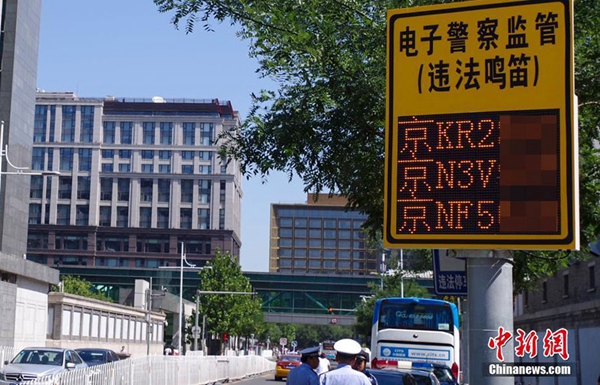
Beijing pilots illegal-honking detectors

Drivers who indiscriminately use their car horns in future could find themselves being booked thanks to a system of detectors being installed along the Chinese capital’s key areas by the Beijing Traffic Management Bureau, according to Beijing Youth Daily.

“The detectors consist of three parts, namely, a microphone array acquisition device, an electronic capture and a LED prompt system. Combining the three systems, we can distinguish between the sounds of horns, brakes and engine noise, etc.,” said Li Jianfeng, deputy director of the Scientific and Technical Information Department of the bureau.

“The detectors can accurately collect honks.” Li said. “Even parallel vehicles can also be identified based on their position in each lane; the recognition locator feature can reflect the direction the honks are coming from, so there will be no misjudgment.”

The system photographs the number plate of the offending vehicle so that the driver can be tracked down and prosecuted.

Honking horns have long been an irritating contributor to Beijing’s noise pollution levels.

According to The Measures of Beijing on the Implementation of the Law of the People’s Republic of China on Road Traffic Safety, violation of the provisions in regard to indiscriminate honking will incur a fine of 100 yuan (US$14.76).

China.org.cn

Categories
Asia Noise News Uncategorized

Sidlab Noise propagation in ducts

Categories
Asia Noise News

The cities with the worst noise pollution

When you think about pollution you probably imagine a smog-filled city, or an ocean choking on plastic.

But pollution extends beyond what’s in the air and the water. Noise pollution, the noise we live with every day, is a growing problem, and it’s affecting our hearing.

Unsurprisingly, noise pollution is particularly bad in cities. A recent study found that Guangzhou in China had the worst noise pollution, while Zurich in Switzerland had the least.

The Worldwide Hearing Index was created by digital hearing app founders Mimi Hearing Technologies GmbH. They analysed the hearing test results of 200,000 of their users.

They combined their results with data on noise pollution from the World Health Organization (WHO) as well as from SINTEF, a Norwegian-based research organization, and used it to plot noise pollution in 50 different cities.

SE Asia is in the well represented with 9 cities in the worst top 20, lot’s to improve !

 Image 1

Typical sources of noise pollution are transport, such as road, rail and air traffic, construction and industry, and radios and televisions blaring in shops, restaurants and bars.

source 

Categories
Asia Noise News

World Hearing Day 2018

Millions of teenagers and young adults are at risk of developing hearing loss due to the unsafe use of personal audio devices such as smartphones and MP3 players and exposure to damaging levels
of sound at noisy entertainment venues including nightclubs, discotheques, bars, pubs and sporting
events. The emerging pattern of listening regularly at high volume and for a long duration poses a serious
threat to one’s hearing. Hearing is a precious faculty, which impacts educational, professional and social
development.
Noise-induced hearing loss can be prevented

CSIR–National Physical Lab


Categories
Asia Noise News

Taiwan: Airport MRT trial run smooth, despite noise concerns

Airport MRT trial run smooth, despite noise concerns

Taipei, Feb. 7 (CNA) The Taiwan Taoyuan International Airport Mass Rapid Transit (MRT) line has been running smoothly since it started trial runs Feb. 2, although there have been noise concerns in one of the neighborhoods through which it passes, the authority that oversees the line’s construction said Tuesday.

The system has been stable as of Feb. 6, the Bureau of High Speed Rail said, adding that the line has carried 34,000 passengers during the five-day period.

There remain some minor bugs in the system, such as signal displays and early checked-in luggage processing, but they are expected to be fixed before the line’s commercial operations begin March 2, the bureau said.

However, more evaluation is required about the noise problem in a New Taipei neighborhood, said bureau Deputy Chief Engineer Jao Kuo-cheng (饒國政).

“We have already installed acoustic walls, but they do not seem to be effective,” he said.

According to the local environment agency, the line is generating around 75 decibels of noise in the area in question, slightly below the maximum limit of 85 decibels but enough to cause complaints from local residents, especially during late hours.

Jao said the bureau will look into the problem and draft a plan in two months to improve the situation.

Categories
Asia Noise News

Hong Kong, construction noise, fines !

Hong Kong (HKSAR) –      The main contractor and sub-contractors of the construction works at Queen Elizabeth Hospital caused noise nuisance by conducting works during holidays. They were convicted and fined a total of $60,000 at Kwun Tong Magistrates’ Courts today (October 26) for contravening the Noise Control Ordinance (NCO).

A spokesman for the Environmental Protection Department (EPD) said that the department received a public complaint this April against construction works being carried out during holidays at Queen Elizabeth Hospital, Yau Ma Tei. EPD staff hence conducted a surprise check at a construction site in the hospital on a Sunday, and found a worker carrying out construction works using an electric grinder.

The emitted noise affected hospital users as the construction site was only 20 metres away from Block D of the hospital. In addition, the contractor and its sub-contractors did not possess a valid Construction Noise Permit (CNP). The EPD subsequently initiated prosecutions against the main contractor and its sub-contractors of the construction works under the NCO upon completion of evidence collection.

According to the NCO, anyone who uses powered mechanical equipment for construction works or carries out prescribed construction works (such as handling debris or hammering) in a designated area during restricted hours (between 7pm and 7am the next day on weekdays or any time on a public holiday) shall apply for a CNP.

The construction works shall commence only when the CNP has been granted upon completion of assessment to support that its noise level would comply with regulatory requirements. First-time offenders are liable to a maximum fine of $100,000. A maximum fine of $200,000 may be imposed on second or subsequent convictions.

hong kong construction noise fines

The spokesman reminded members of the construction sector that they should manage and arrange their works properly.

They should neither use powered mechanical equipment nor carry out prescribed construction works in a designated area during restricted hours. Even with a valid CNP, they should carry out works in strict accordance with the permit, and should also adopt practicable noise mitigation measures, including the erection of fences and noise barriers at the sites, to reduce the impact of noise on the public nearby as far as practicable.

Categories
Asia Noise News

Delhi’s RTR Flyover May Get Noise Barrier Costing INR 20 Cr

Delhi’s RTR Flyover May Get Noise Barrier Costing INR 20 Cr

Jugaad is the exact word when we find a temporary solution for the not-so-temporary problem. And, if a necessary step is not taken in time, someone suffers. So, after years of ‘juggad’, the residents of the RTR flyover area finally have some good news coming.

The existing 900-metre flyover ( which was built in 2009), was a single carriageway till it was decided (in 2014) to construct a parallel one to decongest the existing one. But, the construction kept getting delayed sometimes due to residents moving to court and other hindrances. So, to be precise this new flyover will be 2.7-km-long and the project is expected to be completed by June 2018.

So here is the problematic scenario,

To construct this parallel flyover, the Public Works Department (PWD) sought  Central Road Research Institute’s (CRRI) help. They asked them to study the noise pattern in the nearby areas.

According to the research, it was concluded that noise was loudest during the day at 78-82 dB and further by 10 dB during the night. And this would continue happening if they kept using the current noise barrier, which costs around Rs 1.5 Cr. But, as per standards, the noise limit is 55db in residential areas during the day and 45db in the night. Vasant Vihar, West End and Anand Niketan, Munirka and other areas near Rao Tula Ram Flyover will be affected.

The good news is the CRRI has suggested installing the micro-perforated noise barriers which will absorb noise, unlike the reflective ones which just reflects it and then install them in the nearby areas too.

Here is what Nasim Akhtar, a scientist with CRRI, who has performed the study has to say on the subject.

CSIR-Central Road Research Institute (CRRI)

He said, “We have recommended noise barrier at the flyover as it passes through residential areas. Such noise barriers are used in Taiwan, China and we recently got them installed at BR Ambedkar flyover in Mumbai. This barrier will reduce the noise by 18db-20 dB. It has small holes and the noise from the traffic will go to a box and be absorbed there. The height of the barrier should be 3.5 meters.”

As per their report, “Various traffic surveys in tandem with noise and vibration monitoring were conducted at four locations falling on the flyover corridor to understand the traffic scenario and the noise generated. Due to joints in flyover span, an approximately 10db noise will increase at flyover in the night time. Maximum noise level can even cross 100db.”

“A good noise barrier should be lightweight yet strong and durable, and should also be water/fire resistant. It should also be easy to maintain and assemble and disintegrate,” the report further said. This what a PWD official had to say on after the study has been conducted.

He said, “We have got the study conducted to understand the pattern. They have recommended the high-quality barriers and it is up to the government to decide.”

FYI, Block, concrete, wood or metal, without any added treatment or design behave like the reflective wall. And here is a look at how Absorptive Noise Barrier Walls are a better solution than the Reflective Barrier Walls.

Source

Categories
Asia Noise News

Quiet planes get more slots at Hong Kong airport, a way to curb noise pollution

Trial scheme focuses on non-environmentally friendly and noisy planes – instead of just restricting flights at night

Airlines in Hong Kong are being encouraged to use cleaner and quieter aircraft in return for the chance to operate more flights at night.

A trial is under way for airlines flying out of Hong Kong International Airport to phase out older planes, as such flights contribute to noise pollution – a serious issue at night for nearby residents.

As an incentive, compliance will be rewarded with opportunities to operate more late evening, overnight and early morning flights. The scheme looks to focus on the cause of pollution problems rather than restricting aircraft movements, aviation authorities say.

The trial has already been in effect since March, and is expected to see benefits towards the end of the year if the plan continues on a full-time basis.

“The overarching objective of the quota count scheme is to encourage airlines to use more environmentally friendly aircraft at Hong Kong’s airport,” a spokeswoman for the Civil Aviation Department said.

Under the system, the noisier an aircraft the more points each flight accumulates. By switching to quieter planes fewer points are racked up.

Points go into a pool shared by all airlines, meaning they work together to minimise them and then each shares an equal chance of obtaining new night flight slots.

The scheme was inspired by an identical initiative in Britain.

Amid soaring demand and a lack of space for new daytime flights, the airport is shifting focus to night operations, with dozens of take-off and landing slots to be made available in coming years.

Hong Kong’s biggest airline, Cathay Pacific Airways, has moved to phase out older aircraft or swap noisier planes with the quieter and more fuel-efficient Airbus A350 on routes such as those to Auckland, Melbourne and Dusseldorf.

Hong Kong airport noise pollution
Hong Kong airport noise pollutions

Source

USAThailandMalaysiaIndiaIndonesiaVietnamPhilippines