Categories
Asia Noise News Building Accoustics

Exploring Jakartan Public Transportation Through The Sound

Jakarta, the capital city of Indonesia, is home to 10 millions of Indonesia population. Recently the Indonesian government is being sued by a group of activists and environmentalists due to the unhealthy air quality in Jakarta. The plaintiff hopes that through the lawsuit, the Indonesian government can improve existing policies to address the air pollution issues.

On 18 Jul, according to the Switzerland-based pollution mapping service AirVisual, the Air Quality Index (AQI) of Jakarta is 153, categorized as unhealthy and may cause increased aggravation of the heart and lungs. The recommendation upon this condition is to wear a pollution mask and use air purifiers inside the room. The AQI Measures five criteria air pollutants (particulate matter, sulphur, dioxide, carbon monoxide, nitrogen dioxide, and ozone), and converts the measured pollutant concentration in a community’s air to a number on a scale of 0 to 500.

Air Quality Index – AirVisual

Jakarta is one of the largest urban agglomerations in the world. The uncontrolled increase in urban population is proportional to the number of the vehicle in Jakarta. According to Badan Pusat Statistik (Statistics Indonesia), the growth of motorized vehicle in Jakarta is 5,35% every year, on the other hand, this growth will increase the number of pollution in Jakarta. This statement is supported by the acting head of Jakarta Environment Agency, Andono Warih, the fuel residue of motorized vehicles was the main contributor to severe air pollution as 80 per cent of vehicles powered by diesel fuel operated from Jakarta Greater Area (Jabodetabek) to the capital.

Jakartan can contribute directly to overcome air pollution issues. Public transportation is an environmentally friendly mode of getting around. Because public transportation carries many passengers on a single-vehicle, thus it can reduce the number of vehicles as well as reducing the number of emissions from transportation in a dense urban area. Further, public transportation can help Jakarta to reduce the smog, to meet air quality standards and to decrease the health risk of unhealthy air quality. 

The urban transportation system in Indonesia consists of buses, trams, light rail, metro, rapid transit and ferries. Particularly in Jakarta, urban rail-based transportation, such as Commuter Line Train, Light Rail Transit (LRT) and Mass Rapid Transit (MRT), provides mobility and access to the urban area.

MRT Jakarta Phase 1 – MRT Jakarta

The first phase of MRT Jakarta (MRT-J) has been operating since March 2019. In daily operation, the train runs from Lebak Bulus Grab Station to the Bundaran HI Station. There are 13 stations along the railway; the underground stations are Bundaran HI, Dukuh Atas BNI, Setiabudi Astra, Bendungan Hilir, Istora Mandiri, and Senayan Station. Meanwhile, the overground stations are ASEAN, Blok M, Blok A, Haji Nawi, Cipete Raya, Fatmawati, and Lebak Bulus Grab Station. The MRT-J only needs 30 minutes to travel along the 16 kilometres railway, starting from Lebak Bulus Grab Station in South Jakarta to the Bundaran HI Station in Central Jakarta.

There are 16 train lines available to take the passengers getting around. Based on the MRT-J website, In weekdays operation, the trains operate at 05.00 WIB to 24.00 WIB with a total of 285 trips. Meanwhile, in weekend operation, the trains run at the same hour with a total of 219 trips.

During the promo operation (1 April – 12 May), the average number of daily passengers reached 82,643, whereas after the full tariff was applied, the average per day was 81,459.

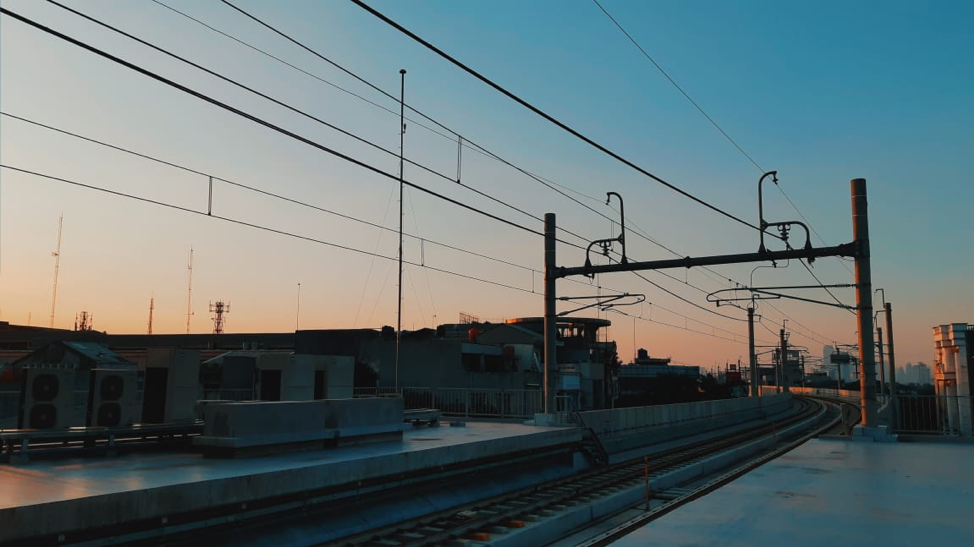
The following pictures will show you the scenes of MRT Jakarta.

So what do you think? Have you tried getting around using MRT Jakarta? If you have never, try immediately and feel the different sensation of Public Transportation in Indonesia.

Further, through this article, I would like to invite you, explore the MRT Jakarta through a different perspective, that may be for a group of people this method is still rarely used, a sound.

Do you realize that sound can tell us about character, place, and time? Sometimes, it informs us in ways visuals can’t, and that is the idea of what we are going to do right now. Later you will hear, a file of recorded sound of MRT-J in its daily operation.

The sound was recorded by the soundwalk method, any excursion whose primary purpose is listening to the environment. It is exposing our ears to every sound around us no matter where we are. We may be at home, walking across a downtown street, or even at the office. Meanwhile, in this case, our environment is inside the line of MRT Jakarta. The goal is to capture any sound sources that exist during the operation of MRT-J, including the activity of the passengers.

The sound was recorded by using a mounted microphone on the iPhone X at a level of 1.2 m above the ground. The following sound is a recorded environment while the MRT-J was travelling from Bundaran HI Station to Setiabudi Astra Station, the duration of recording sound is 4 minutes and 40 seconds. Please use an earphone or any similar devices to listen to the audio for a better experience.

Caution: please set the volume around 50 – 70 % of the maximum volume.

After listening to the sound, can you identify what sound sources are presented in the recording? Here are the sound sources that I have identified:

  1. Engine sound increases speed
  2. Public Address system
  3. Engine sound
  4. Rail friction
  5. Passengers’ activities (cough, sneeze, conversation, footsteps, etc.)
  6. The sound of the door opening
  7. Brake squeak

Now we have identified the sound sources that are presented in the recording. But, do you know how many decibels that I have to endure while travelling using the MRT-J? In this article, manual measurements of noise levels were performed with a sound level meter in the MRT Jakarta with passengers on its usual route. A-weighted sound level measurements were recorded directly from one station to the next during the time between 08:00 and 09:00, using a calibrated microphone on a stand at a level of 1.2 m above the ground. The results of equivalent continuous A-weighted noise levels Leq (LAEq) in the MRT-J with passengers on its usual route from one station to the next is shown in Chart 1. 

Leq is the A-weighted energy means of the noise level averaged over the measurement period. The results from the measurements show that the A-weighted noise level is varied between 77 dB to 82 dB. Further, if we look closely into the Chart, the noise level is fluctuating. It can be caused by a lot of factors, such as: 

  1. The position of MRTJ (When MRT-J inside the tunnel, the noise can be levelled up due to the reflection phenomenon).
  2. Speed (The machine indicates producing a higher noise when in the maximum speed).
  3. Path Crossing.
  4. The Public Address System Volume.

Moreover, the level of continuous noise in Chart 1 represents a quite noisy environment. According to The National Institute on Deafness and Other Communication Disorders, states that Long or repeated exposure to sound at or above 85 dB can cause hearing loss. Thus, according to the measurement results, I suggested you wear ear protection during commuting by MRT-J. The earplug is one of the equipment that we can use to protect our hearing; you only need to spend a few thousand rupiahs for this. Wearing earplugs can help you to reduce the noise by 18 – 34 dB, it depends on the models/brand. For more accurate results, we need to do a complex measurement, such as:

  1. Add measurement point (In this article, the measurement was done only in a measurement point, at the second car of the line).
  2. Add a velocity as a measured parameter.
  3. Add the measurement time; the measurement can be done during the operation hour, non-stop. (05:00 – 24:00 WIB).

Nonetheless, the idea of showing the measurement results is spreading noise awareness. Noise sticks with you around, even common sounds you hear at work or home can contribute to long term hearing loss and other health risks, they are everywhere, but only a few people are aware of it. Noise pollution is a health threat nobody is talking about. Here are some parameters to help you determine acceptable — and dangerous — noise levels:

  • 45 dB: nightly noise ordinance threshold set by many municipalities concerned with industrial noise exposure for residents
  • 65 db+: exposure for prolonged periods can cause physical and mental fatigue
  • 85 dB+: can cause permanent hearing loss if exposed for extended periods
  • 85-120 dB: dangerous over 30 minutes of exposure
  • 120-130 dB: can cause permanent hearing loss for exposure over 30 seconds
  • 130 dB+: not only are these noises painful, but hearing protection should always be used if avoidance is not possible.

Everyone needs to take care of their ears and hearing, as damage to the auditory system could be irreparable. The loss because of the noise exposure is gradual; you might not notice the signs, or you ignore them until they become more apparent. Please do protect your ears. 

Reference:

https://www.theguardian.com/world/2019/jul/02/jakarta-residents-to-sue-government-over-severe-air-pollution

http://support.airvisual.com/knowledgebase/articles/1185775-what-is-aqi

https://doi.org/10.1016/j.ecss.2018.10.017

https://jakarta.bps.go.id/publication/2018/10/03/cb1285d8dbe8be8754a5830d/statistik-transportasi-dki-jakarta-2018.html

https://en.tempo.co/read/1214627/jakarta-air-pollution-mostly-caused-by-motorized-vehicles-agency

https://www.nationalexpresstransit.com/blog/why-is-public-transportation-good-for-the-environment/

https://www.businesstimes.com.sg/asean-business/indonesia-accelerating-urban-transportation-development-with-public-private

Westerkamp, Hildegard (1974). “Soundwalking”. Sound Heritage

https://www.ncbi.nlm.nih.gov/pmc/articles/PMC5308171/

https://www.sensear.com/blog/noise-is-everywhere-how-to-deal-with-it-does-it-create-a-dangerous-environmenthttps://www.womenshealthmag.com/health/a19599097/noise-pollution/

Categories
Asia Noise News Building Accoustics

Feeling Unproductive? You Might be Overlooking This Productivity Killer

Feeling Unproductive in Office – GeoNoise Asia

We believe that the best way to be highly productive is to be able to get into our monoideal state. Josh Kaufman says in his book “The Personal MBA”:

Monoidealism is the state of focusing your energy and attention only on one thing. It’s often called a “flow” state: clear, focused attention on one subject for a long period of time.”

For this to happen, potential distractions and interruptions need to be eliminated. This is the reason for some people, working early in the morning or late at night can feel very productive – because on a normal day, no one is going to call you at 4 in the morning.

However, most of us do our work in an office which does not operate at those silent, undistracted hours. The good news is, we still can manage our potential distractions by knowing what distracts us the most. This can be done by allocating a time when you want to be in your monoideal state and free yourself from distractions during that time. For example, you can put your phone into flight mode and turning off email notifications from 8 to 11 and start to check emails and communicating with the outside world from 11 until lunch. The timing will depend a lot on the type of work you are doing and how much time will you need to be in monoideal state.

Unfortunately, there are things that is out of your locus of control – there is a retrofitting job upstairs, your co-worker decided to sing along to the song he is listening to, people in the other room are laughing loudly (are they talking about their boss?) and so on. If it’s not in front of your eyes, for example pop-up notifications on your screen, most of the distractions come to you in a form of sound, or I think it’s better to call it “noise”.

Noise is a productivity killer that you might be overlooking, especially if you have passed the stage of being distracted by your phone, browsing Facebook on your computer and looking at cat videos on Youtube. Fortunately, noise is manageable in a few different ways. The most viable option for an existing office is to make noise-related rules and to make everybody aware that noise can reduce their productivity. For example, companies can make rules that retrofitting job, singing and gossiping must be done outside of office hour. Another way to fix this is to separate areas for people who want to be focused and areas where people can socialize and discuss with their co-workers.

The best way to manage noise? Is to take noise into consideration from the beginning of the design process of the working space. This can be a long and complex process where there are a lot of aspects to be considered in designing an ideal office. It needs a balance between visual pleasure, company’s philosophy, functionality, health, safety and all other aspects that we want to take into account. A lot of times, all those aspects will relate to noise or acoustics in some ways, depending on each unique case.

For us acousticians, these are the things that we typically think about when helping others to design their working space (and actually any other built environment):

  • Ambient noise: We want the noise level inside of the working space to be reasonably low, whether it is intrusion from outside such as traffic, railway, aircraft and neighbouring building (neighbour’s mechanical system can be quite noisy), or the noise from inside the building such as HVAC system and lifts.
  • Sound insulation: We don’t want to hear sound that we don’t want to hear from the next room, upstairs or downstairs. By designing a suitable ceiling, flooring and wall systems, a sufficient sound insulation can be achieved.
  • Room acoustics: We want to be able to listen comfortably and understand verbal information that we want to. This is critical especially in meeting rooms and event space.
  • Sound reinforcement and public address system: We want the sound reinforcement and public address system to be heard clearly while not disturbing others who don’t want to hear it.

All the above can also be done after the building and the working space is built. But if it’s done before it’s built, you will have a lot more options and be more cost efficient rather than changing what is already been built.

So, if you are a highly productive person, or if you want to become one, we would suggest you to consider noise in choosing the space you are working in.

Categories
Asia Noise News Building Accoustics

Are You Stressed at Work?

Are you stressed at work?

How many times did you need to cover your ears at work? You might be stressed because you are working in a noisy environment even without realizing it.

A noisy environment is one of the primary stress triggers for the employee and it will lead to a reduction in productivity. It is dangerous for your health but it could also impact your bonus at the end of the year? Let us remind you how noisy your working environment is by mentioning some sources:

  • Copy machines
  • Obnoxious ringtone
  • Computers
  • Air Conditioning
  • Noises from outside the office buildings (Trucks, Airplanes, Highway noise, nearby constructions)
  • Laughing/Talking
  • Gossip about boss
  • Gossip about co-worker who is not invited into WhatsApp Group

Those are common noise sources that might be contributing to the noise around you. We must remember that the distinction between noise and sound is very subjective. It can be particular to each person and even depend the situation.

Noise and sound can both be dangerous for your health and can be easily measured to quantify. The graphic below shows some noise levels. Fifty decibel would be great for a working environment, exposure for long time to noise levels above 80 decibel will permanently damage your hearing.


How Loud is Too Loud? – GeoNoise Asia


After reading the graphic, please take a moment to think about how many decibels your ears have to endure daily? Let’s say that you’re working in a general business noisy office. The noise levels can be reaching up to 90 decibels because of the cumulation of various noises such as laughter, yelling, ringtones, etc. The World Health Organization (WHO) claims that exposure to noise causes stress, anxiety, depression, high blood pressure, and heart disease. Furthermore, loud sounds will damage sensitive structures of the inner ear and cause noise-induced hearing loss (NIHL).

The damage because of the noise exposure is gradual; you might not notice the signs or you ignore them until they become more apparent. Here are the symptoms of the Noise-induced Hearing Loss:

  • Sounds have become distorted or muffled
  • You can hear people, but you can’t quite understand what they’re saying
  • You can’t hear or understand speech from 3 feet away or farther
  • You must turn the volume up more than others do in order to hear it as well as they can

All checked?

Please call professional help immediately! If it is not, congratulations, you still have a good hearing. But it doesn’t guarantee you that you will be free from NIHL.

Here are the tips on how to stay sane in a noisy working environment and prevent the NIHL at the same time:

•   Bring earplugs to your work!

You only need to spend a few thousand rupiahs for this. Wearing earplugs can help you to reduce the noise by 18 – 34 decibels. It depends on the models/brand. By blocking/reducing that amount of noise, you’re still able to hear the sound around you.

•   You might want to try the Noise Cancelling Headphones

It is made for keeping the noise away from your ears. If you use this in the office, it not only will help you block the annoying noise but also will make your music sounds way better than any other headphones in the same situation. The price ranges between a hundred thousand rupiah – millions of rupiah. It is an excellent investment, though!

•   Take a break!

When the noise around you is too much to handle, give your ears a break! It gives your eara time to recover from the stressful sound and this action also a preventive way to the damage of your ears. None of them seems to be working for you? Please contact the acoustical consulting service. They will help you to find the best solutions to your problems.

Categories
Asia Noise News

The cities with the worst noise pollution

When you think about pollution you probably imagine a smog-filled city, or an ocean choking on plastic.

But pollution extends beyond what’s in the air and the water. Noise pollution, the noise we live with every day, is a growing problem, and it’s affecting our hearing.

Unsurprisingly, noise pollution is particularly bad in cities. A recent study found that Guangzhou in China had the worst noise pollution, while Zurich in Switzerland had the least.

The Worldwide Hearing Index was created by digital hearing app founders Mimi Hearing Technologies GmbH. They analysed the hearing test results of 200,000 of their users.

They combined their results with data on noise pollution from the World Health Organization (WHO) as well as from SINTEF, a Norwegian-based research organization, and used it to plot noise pollution in 50 different cities.

SE Asia is in the well represented with 9 cities in the worst top 20, lot’s to improve !

 Image 1

Typical sources of noise pollution are transport, such as road, rail and air traffic, construction and industry, and radios and televisions blaring in shops, restaurants and bars.

source 

USAThailandMalaysiaIndiaIndonesiaVietnamPhilippines