Categories
Southeast Asia Noise Nuisance Case Law

When “Normal” Noise Wins: Supreme Court of the Philippines on HVAC Nuisance in Makati CBD

A 2020 decision in Frabelle Properties Corp. v. AC Enterprises, Inc. (G.R. No. 245438) from the Supreme Court of the Philippines has become a reference point for HVAC noise disputes in dense business districts. The full judgement is available on the court’s own website. The case involved long-running complaints about air-conditioning blowers on one high-rise sending noise and hot exhaust air towards a neighbouring mixed-use condominium in the Makati Central Business District. Despite years of pressure, measurements and enforcement attempts, the final judgement refused to treat the remaining noise as an actionable nuisance.

For stakeholders across Southeast Asia, this dispute is a strategic reminder that environmental noise cases turn not only on decibel values, but also on location, mitigation history and proof of impact on people with ordinary sensibilities. It also shows where specialist acoustics input and expert witness work can materially shift the outcome.


Background: blowers, complaints and competing measurements

The dispute arose between the owner of a mixed-use tower that managed residential and commercial tenants, and the owner of a nearby building whose façade carried 36 condenser blowers serving air-cooled chillers. The equipment was mounted on several floors, facing directly towards living spaces across a relatively narrow street. Residents reported continuous mechanical noise and warm exhaust air that allegedly made balconies unusable and reduced rental values.

Local environmental officers and the Environmental Management Bureau of the Philippines carried out several sound level measurements during the 1990s and around the turn of the century. Some of the earlier tests recorded levels above the commonly cited 65 dB guideline for that type of urban zone. The City Government of Makati eventually issued a cease-and-desist order and required mitigation.

In response, the plant owner implemented a progressive package of engineering controls: replacing some blowers, adding sound-attenuating elements and re-routing discharge so that hot air no longer blew directly at the neighbouring façade. Follow-up measurements commissioned by the city showed sound pressure levels in the low-60-dB range at critical receiver positions, which sat within the municipal benchmark for a commercial district.

Despite this, the complaining owner maintained that the HVAC plant remained intolerably loud and continued to pursue relief through the courts.


First-stage judgment: trial court finds a private nuisance

At first instance, the regional trial court accepted the narrative that blower noise was still excessive. The court relied heavily on historical exceedances, on anecdotal statements from inspectors and on witness testimony from a resident who described sleep disruption, discomfort and the need to keep balcony doors closed while operating her own air-conditioner constantly.

On that evidentiary base, the trial court concluded that the HVAC plant created a private nuisance and granted a permanent injunction alongside financial compensation for alleged lost income.

normal noise wins in Philippines noise court case

Appellate reversal: evidence and context re-evaluated

On appeal, the higher court was more sceptical. It noted that later sound level measurements, taken after mitigation works, showed compliance with the applicable noise limits for the area. Historic measurement reports, while not irrelevant, were given less weight because they did not reflect the situation at the time of judgement.

The appellate court also questioned whether the claimant had demonstrated disturbance to a person of ordinary sensibilities. The fact that only a single tenant testified, without broader survey data or medical evidence, made it difficult to prove that the residual noise exceeded what a reasonable resident should expect in a busy business neighbourhood.

The injunction and damages award were therefore set aside.


Final outcome: high court confirms “no actionable nuisance”

When the case reached the highest level, the court affirmed the appellate decision and clarified three key principles for environmental noise disputes in dense urban zones:

  1. Locality matters. Noise is assessed in context. What may be intolerable in a quiet suburb can be considered normal in a central business district characterised by traffic, plant rooms and 24/7 building services.
  2. Compliance data beats historic exceedances. If current operations demonstrably meet the relevant standard for the zone, older exceedance data will not usually justify severe remedies like shutdown orders or large damages.
  3. Impact on ordinary people must be proven. Courts look for disturbance to a reasonably tolerant, typical resident – supported by multiple testimonies, logs, or expert and medical evidence – not just by the accounts of a particularly sensitive individual.

The decision does not say that HVAC noise can never be a nuisance; instead, it holds that the evidence in this specific dispute fell short of that threshold once mitigation had been implemented.


Implications for developers, operators and regulators in Southeast Asia

Developers and property owners

  • Integrate acoustics early in design: treat external units, cooling towers, chillers and exhaust fans as critical noise sources that must be modelled, not afterthoughts.
  • Design to meet noise limits with a safety margin, accounting for equipment ageing and potential future complaints.
  • Create a formal log of complaints, site visits, measurements and mitigation works; long-term documentation can be decisive in litigation.

Facility and EHS managers

  • Commission independent baseline measurements before and after major plant changes.
  • Document instruments, settings, locations and weather conditions so that reports are court-ready.
  • When complaints arise, combine technical findings with human impact data (sleep diaries, disturbance logs, tenant surveys) to show that the issue is being managed transparently.

Regulators and local authorities

  • Use clear, zoning-based criteria and publish test procedures to reduce disputes about methodology.
  • Prefer current, traceable measurements over informal observations when deciding whether enforcement is justified.
  • Where internal capacity or equipment is limited, engage independent acoustic consultants to ensure defensible results.

How Geonoise Asia can support future cases

For noise disputes around building services, plant rooms and mixed-use developments, Geonoise Asia can add value at each stage of the lifecycle:

  • Pre-project advisory: predicting HVAC and equipment noise using modelling, and recommending layouts or enclosures that minimise risk before construction.
  • Compliance and optimisation: performing sound level surveys, interpreting local standards, and advising on practical mitigation that balances acoustics, energy and cost.
  • Dispute resolution and expert witness work: preparing clear, traceable reports and visualisations that decision-makers can understand, and providing independent expert testimony when required.

By combining strong technical methods with a clear understanding of how courts analyse nuisance, Geonoise Asia helps owners, operators, regulators and communities achieve solutions that are both acoustically robust and legally defensible.

Categories
Asia Noise News Southeast Asia Noise Nuisance Case Law

Why this Thai case matters for noise nuisance disputes in Southeast Asia

In 2024, the Supreme Administrative Court of Thailand issued decision A.58/2567 in a dispute between a tofu factory and local authorities. The case looks simple on the surface – neighbours complained about night-time noise from factory operations – but the judgment sends a strong message to regulators and operators across Southeast Asia: noise nuisance orders must be backed by defensible technical evidence, not just assumptions or feelings.

For Geonoise Asia, this is exactly the type of case where independent acoustic expertise, correct measurements and robust documentation make the difference between a legally sustainable order and one that will be struck down on appeal.

Case background: complaints about tofu factory noise

Residents in an urban neighbourhood complained that a tofu factory was operating at night using machinery and activities that allegedly generated disturbing noise – from production equipment and cleaning to handling water, moving carts and talking. Local officials treated the factory as a potential “health-hazardous business” under Thailand’s Public Health Act B.E. 2535 (1992) and opened an investigation.

Health officers attempted to take sound measurements at the complainant’s house. The resident did not allow instruments to be placed inside the dwelling, so the team installed a meter outside the house for three days. During that period, the tofu production did not run at night and no decisive evidence of excessive noise was captured. Authorities therefore had no measured data showing that noise levels breached any statutory limit.

Despite this, the district director – acting as the local public health authority – issued a formal nuisance abatement order under Section 28 of the Public Health Act. The order instructed the factory owner to “correct and improve” operations and to avoid any actions that would cause noise disturbance at night.

The factory appealed to the Minister of Public Health but received no effective response, and ultimately brought the matter before the Administrative Court, asking for the abatement order to be revoked. The first-instance Administrative Court dismissed the claim and upheld the order, so the operator appealed to the Supreme Administrative Court.

What the Supreme Administrative Court decided

At the heart of the case was a very practical question: can a nuisance order be based on assumptions that noise is “likely” to exceed legal limits, without any compliant measurement?

The Court examined the relevant Thai technical standards, in particular:

  • The National Environmental Board (NEB) notification on environmental noise limits, which treats noise as a nuisance when the level exceeds background noise by more than 10 dB(A).
  • The Department of Health notification on nuisance criteria for noise, which aligns with the same 10 dB(A) concept and requires methodical measurement.

The Court noted that the district office had never actually measured and calculated whether the factory’s noise exceeded background by more than 10 dB(A) during real operating conditions. The only documented conclusion was that if night-time production took place, it “might” disturb nearby residents. There was no quantitative proof, no properly documented measurement session at the relevant times, and no calculation showing a breach of the 10 dB(A) threshold.

On that basis, the Supreme Administrative Court held that:

  • A local authority may have power to issue nuisance abatement orders, but that power must be exercised on the basis of reliable technical evidence, not only on subjective impressions or speculative assessments.
  • Because no compliant sound measurements were carried out, the authority had not demonstrated that the legal criteria for “noise nuisance” were met.
  • The abatement order was therefore unlawful and had to be revoked.

In simple terms: even if neighbours sincerely feel disturbed, the law requires that a noise nuisance be proven using accepted measurement methods and thresholds; “it probably exceeds the standard” is not enough.

Key legal and technical principles from this case

  • Scientific evidence is mandatory. For noise nuisance, authorities must rely on correctly executed sound measurements – including equipment, locations, time periods and reference standards – not purely on complaints or officers’ subjective impressions.
  • The 10 dB(A) rule matters. In Thailand, environmental and public health regulations treat noise as a nuisance when it exceeds background noise by more than 10 dB(A). Without that differential being established, enforcement is on shaky ground.
  • Procedural errors can invalidate orders. If an authority issues a closure or abatement order without going through the legally required measurement and documentation steps, affected operators can challenge the order in court and obtain its cancellation.
  • Courts expect professional practice. Environmental and neighbour-noise cases must be built on strong factual and technical foundations, not assumptions.

Implications for regulators, operators and communities in Southeast Asia

For regulators and local authorities

  • Do not issue noise nuisance orders without a traceable measurement campaign aligned with your national standards.
  • Document sound level meter type, calibration, locations, measurement periods, background levels and calculations.
  • Consider partnering with independent acoustic consultants where internal expertise or equipment is limited.

For factories, venues and hospitality operators

  • Proactively commission baseline noise surveys around your facility, especially for night-time operations.
  • Maintain a measurement record to show regulators and courts that your operations comply with limits, or that you have a mitigation plan in place.
  • If you receive a nuisance order, check whether it is supported by proper measurements; if not, you may have legal arguments based on this precedent.

For residents and communities

  • Complaints are still important – they trigger investigations – but attaching recordings and indicative sound level readings will increase their weight.
  • Court cases are more likely to succeed when community testimony is supported by objective measurements from recognised methods and instruments.

How Geonoise Asia can support as expert witness and technical partner

This case is a textbook example of why independent acoustics expertise is critical in noise disputes:

  • Authorities need coherent, standards-based measurements to sustain their orders.
  • Operators need robust counter-evidence to challenge orders that are not properly substantiated.

Geonoise Asia can support public and private stakeholders throughout Southeast Asia by:

  • Designing and executing noise measurement campaigns that follow national and international standards.
  • Preparing clear, court-ready reports that explain methodology, uncertainty and compliance in language judges and lawyers can work with.
  • Acting as independent expert witnesses in administrative and civil proceedings where noise levels, nuisance and mitigation measures are in dispute.
  • Helping regulators and municipalities build internal procedures for defensible measurements and documentation.

For local authorities, that reduces litigation risk and increases public trust. For operators, it ensures that your side of the story is backed by credible data. For communities, it means noise complaints are treated seriously and resolved on the basis of facts, not just emotion.

Checklist: building a defensible noise nuisance case

Whether you are a regulator, operator or community representative in any Southeast Asian country, this Thai judgment suggests a simple checklist:

  • Define the relevant legal standard (for example, 10 dB(A) above background, night-time limits, zoning rules).
  • Plan the measurement (locations, time windows, instrumentation, calibration, background measurements).
  • Record and store raw data and logs – not just summary numbers.
  • Analyse and report with traceability so that another expert can independently review your findings.
  • Engage independent acoustics experts early when you expect the dispute may escalate to court.

Geonoise Asia is ready to support stakeholders across Thailand, Malaysia, Indonesia, Vietnam, Singapore and the wider region who need evidence-based, defensible solutions to noise nuisance disputes – from early complaint investigations all the way to expert testimony in court.

Categories
Environment Industrial Noise and Vibration Product News

Noise Monitoring for your home, Thailand


The first DIY noise monitoring, easy to use and install, just plug in the power, wifi and ready to go, online data noise monitoring, accurate, calibrated, weatherproof. Automated alarms by email or messenger.

Noisy neighbours, noise from entertainment or from a factory, road noise?

Register the noise and discuss with the authorities how to resolve the issue.

SpotNoise noise monitoring from the Netherlands, now available via Geonoise Thailand for South East Asia.


Noise Nuisance Monitoring Thailand Noise Nuisance Monitoring Thailand, Malaysia, Indonesia, Vietnam


Categories
Asia Noise News Building Accoustics

Railway Noise

Rail transport or train transport is one of the main transportation modes these days, both for transferring passengers and goods. Every day people commute to work and back home using trains in a form of subway systems, light rail transits and other types of rail transport. These types of system can create noise both to the passengers inside of the train as well as to the environment. In this article, we will discuss about noise source components that we hear daily both inside and outside of the train.

If we pay attention to the noise when we are on board of a train, there are more than one noise source that we can hear. The main sources for interior noise in a train are turbulent boundary layer, air conditioning noise, engine/auxiliary equipment, rolling noise and aerodynamic noise from bogie, as illustrated in the following figure.

By the way, we wrote and recorded the sound of Jakarta MRT. You can see the link below to help you imagine the train situation better.

Exploring Jakartan Public Transportation Through The Sound

Rolling noise is caused by wheel and rail vibrations induced at the wheel/rain contact and is one of the most important components in railway noise. This type of noise depends on both wheel and rail’s roughness. The rougher the surface of both components will create higher noise level both inside and outside of the train. To be able to estimate the airborne component from the rolling noise, we must consider wheel and track characteristics and roughness.

Another noise component that contributes a lot to railway noise is aerodynamic noise which can be caused by more than one sources. These types of sources may contribute differently to internal noise and external noise. For example, aerodynamic noise contributes quite significantly at lower speeds to internal noise while for external noise, it doesn’t contribute as much if the train speed is relatively low. For example, on the report written by Federal Railroad Administration (US Department of Transportation), it is stated that aerodynamic sources start to generate significant noise at speeds of approximately 180 mph (around 290 km/h). Below that speed, only rolling noise and propulsion/machinery noise is taken into consideration for external noise calculation. In addition to external noise, machinery noise also contributes to the interior noise levels. This category includes engines, electric motors, air-conditioning equipment, and so on. 

To perform the measurements of railway noise, there are several procedures that are commonly followed. For measurement of train pass-by noise, ISO 3095 Acoustics – Railway applications – measurement of noise emitted by rail bound vehicles, is commonly used. This standard has 3 editions with the first published in 1975, and then modified and approved in 2005 and again in 2013. The commonly used measures for train pass-by are Maximum Level (LAmax), Sound Exposure Level (SEL) and Transit Exposure Level (TEL).

For interior noise, the commonly used test procedure is specified in ISO 3381 Railway applications – Acoustics – Measurement of noise inside rail bound vehicles. This procedure specifies measurements in few different conditions such as measurement on trains with constant speed, accelerating trains from standstill, decelerating vehicles, and stationary vehicles. 

Written by:

Hizkia Natanael

Acoustical Design Engineer

Geonoise Indonesia

hizkia@geonoise.asia

Reference:

D. J. Thompson. Railway noise and vibration: mechanisms, modelling and means of control. Elsevier, Amsterdam, 2008

Federal Railroad Administration – U.S. Department of Transportation, High-Speed Ground Transportation Noise and Vibration Impact Assessment. DOT/FRA/ORD-12/15. 2012

Categories
Asia Noise News

Noise, Nuisance or Danger

As an introduction to this question some basic facts about noise.

Basic noise facts

Noise is typically defined as ‘unwanted sound’. The unit for sound is the Decibel which is a value calculated with logarithms from the pressure to get a scale from 0 to 120 dB where 0 dB is the hearing threshold for a young person with healthy hearing and 120 dB is the pain threshold.

We can state that noise is a type of energy created by vibrations. When an object vibrates it causes moment in air particles. The particles will bump into each other and will generate sound waves, they are ongoing until they run out of energy.

High and low tones are perceived by our hearing due to fast and slow vibrations.

Sound needs a medium to travel and the speed of sound is around 340 meter per second. Examples of typical noise levels:

Due to the nature of the calculation of Decibels we cannot just add them together.

Examples:

3 dB + 3 dB = 6 dB

But…..

10 dB + 10 dB is not 20 dB but 13 dB

The Decibel (sound pressure level) for sound in air is relative to 20 micro pascals (μPa) = 2×10⁻⁵ Pa, the quietest sound a human can hear.

The human hearing system

The human hearing system is capable of hearing sounds between 20 Hz and 20000 Hz. Below 20 Hz is called infra sound and above 20000 Hz is called ultrasounds. Both infra- and ultrasound is not audible for us. Elephants however can hear frequencies as low as 14 Hz and bats can hear frequencies up to 80000 Hz.

A special noise weighting for the human perception has been introduced in the 1930’s and called the A-weighted Decibel, dB(A). This was introduced to align the noise levels with the sensitivity and physical shape of the human hearing system.

Basic human hearing system

When sound waves enter the ear, they travel up the ear canal and hit the ear drum, the ear drum will vibrate and the three smallest bones in the human body will transfer these vibrations to the fluid in our inner ear’s sensory organ the cochlea. The sensory hair cells will vibrate which will send nerve impulses to the brain, the brain will translate these impulses for us and we perceive sound!

Dangers of noise

Noise from certain music can be a very pleasurable sound for one person and a horrific noise for another. From this fact we can see that noise is not only an absolute value but also strongly depending on the receiver’s mindset.

However, there are some clear absolute values concerning the danger levels of noise.

  • Generally accepted as safe is spending 8 hours per day in an environment not exceeding 80 dB(A)
  • NOT safe would be to spend 1 hour in a disco with levels at 100 dB(A) which are easily exceed nowadays

Apart from the obvious hearing loss there are many other issues that can arise from exposure to (too) high noise levels such as:

  • Hypertension
  • Heart disease
  • Annoyance – stress
  • Immune system – psychosomatic

The positive side to remember is that Noise Induced hearing loss is 100% preventable!!

Worldwide solutions

Governments (especially in Europe) know the actual cost of high noise exposure and they concluded that protecting their citizens from high noise exposure (during working hours, recreation as well as during sleep) is far more effective than dealing with the costs of citizens enduring high noise related illnesses, demotivation, sleep disturbance etc.

They are investing in quiet schools (optimal learning environment), quiet hospitals (patients recover a lot faster in quiet wards), implement city planning to create quite zones.

Of course, they also have strong noise regulations that are being enforced.

Acoustical societies worldwide help to create awareness and leverage noise legislations with governments.

Noise in Asia

I have been living in Asia for the last 15 years and of course I noticed it’s noisy. Noise regulations (if exist at all) are very lenient and mostly not enforced. I’m very happy to see that Acoustical Societies are coming up in Asian countries and can convince governments to invest in setting up proper noise regulations and enforcing them. I’m very happy to be able to contribute to a quieter world by creating more awareness for the dangers of noise!

Categories
Building Accoustics

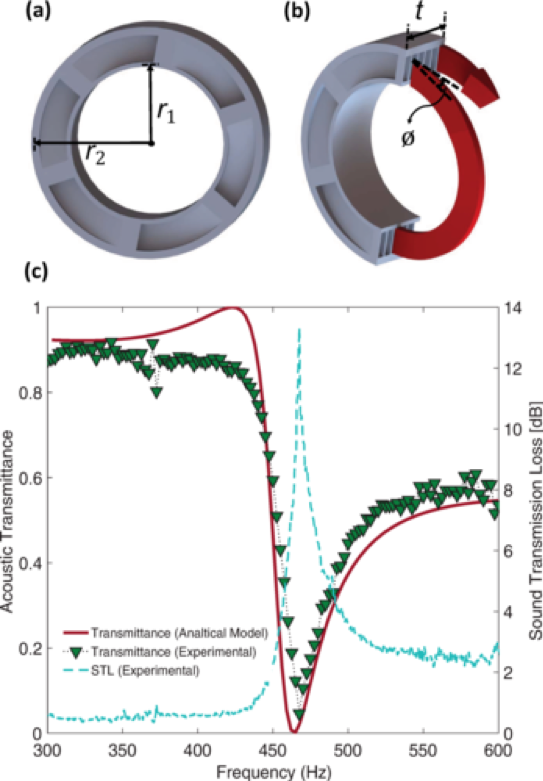
Researchers Develop ‘Acoustic Metamaterial’

Boston University researchers, Xin Zhang, a professor at the College of Engineering, and Reza Ghaffarivardavagh, a Ph.D. student in the Department of Mechanical Engineering, released a paper in Physical Review B demonstrating it’s possible to silence noise using an open, ring-like structure, created to mathematically perfect specifications, for cutting out sounds while maintaining airflow.

They calculated the dimensions and specifications that the metamaterial would need to have in order to interfere with the transmitted sound waves, preventing sound—but not air—from being radiated through the open structure. The basic premise is that the metamaterial needs to be shaped in such a way that it sends incoming sounds back to where they came from, they say.

As a test case, they decided to create a structure that could silence sound from a loudspeaker. Based on their calculations, they modeled the physical dimensions that would most effectively silence noises. Bringing those models to life, they used 3-D printing to materialize an open, noise-canceling structure made of plastic.

Trying it out in the lab, the researchers sealed the loudspeaker into one end of a PVC pipe. On the other end, the tailor-made acoustic metamaterial was fastened into the opening. With the hit of the play button, the experimental loudspeaker set-up came oh-so-quietly to life in the lab. Standing in the room, based on your sense of hearing alone, you’d never know that the loudspeaker was blasting an irritatingly high-pitched note. If, however, you peered into the PVC pipe, you would see the loudspeaker’s subwoofers thrumming away.

The metamaterial, ringing around the internal perimeter of the pipe’s mouth, worked like a mute button incarnate until the moment when Ghaffarivardavagh reached down and pulled it free. The lab suddenly echoed with the screeching of the loudspeaker’s tune.

How acoustic metamaterial works – Geonoise Asia

Now that their prototype has proved so effective, the researchers have some big ideas about how their acoustic-silencing metamaterial could go to work making the real world quieter.

Closer to home—or the office—fans and HVAC systems could benefit from acoustic metamaterials that render them silent yet still enable hot or cold air to be circulated unencumbered throughout a building.

Ghaffarivardavagh and Zhang also point to the unsightliness of the sound barriers used today to reduce noise pollution from traffic and see room for an aesthetic upgrade. “Our structure is super lightweight, open, and beautiful. Each piece could be used as a tile or brick to scale up and build a sound-canceling, permeable wall,” they say.

The shape of acoustic-silencing metamaterials, based on their method, is also completely customizable, Ghaffarivardavagh says. The outer part doesn’t need to be a round ring shape in order to function.

“We can design the outer shape as a cube or hexagon, anything really,” he says. “When we want to create a wall, we will go to a hexagonal shape” that can fit together like an open-air honeycomb structure.

Such walls could help contain many types of noises. Even those from the intense vibrations of an MRI machine, Zhang says.

According to Stephan Anderson, a professor of radiology at BU School of Medicine and a coauthor of the study, the acoustic metamaterial could potentially be scaled “to fit inside the central bore of an MRI machine,” shielding patients from the sound during the imaging process.

Zhang says the possibilities are endless, since the noise mitigation method can be customized to suit nearly any environment: “The idea is that we can now mathematically design an object that can block the sounds of anything”.

Source:

https://phys.org/news/2019-03-acoustic-metamaterial-cancels.html

Categories
Asia Noise News Building Accoustics

Noise and Vibration Monitoring for Construction Sites

In a densely populated city like Bangkok, most of the construction projects are surrounded by condominiums, offices or residential areas. The construction sites must control the noise and vibration that may affect the surroundings. Construction sites need to control the noise and vibration levels that they produce following the EIA standard.

To manage this, noise and vibration instruments are installed which automatically will send alarms to the construction company if the thresholds are exceeded.

Noise Monitoring Station

Sound level meter class 2 according to IEC61672-1 standard which can collect the data of SPL, LEQ and LMAX. These instruments are calibrated before they are installed at a construction site. The system has a LED display and warning light when noise levels in the site are over a trigger level, which is referred to in the standards for maximum sound levels around construction sites.

According to the announcement of National Environment Board no.15 BE.2540 (1997) in the topic of “Standard loudness”, the average sound 24 hour must not exceed 70 dBA and the maximum peak level must not exceed 115 dBA.

Sound level meter are designed to be used outdoors and an additional LED display was added by Geonoise which is a professional sound and vibration company. Sound level meter with LED display also can analyse the loudness in percentile (Statistical,Ln) or analyse the frequencies in 1/1 and 1/3 octave bands. In addition to storing vibration data, you can also create level notifications in Alarm Alert format before vibration levels exceed the standard value for monitoring the activities being performed.

Vibration Monitoring

In the construction industry, transportation Industry and most large industries vibrations will occur.
High vibration levels will cause structural damage to buildings, bridges, structures as well as nuisance or health risks to occupants in exposed (residential) buildings.

Therefore, it is necessary to comply with the standard of vibration in a building according to the Announcement of the National Environment Board Announcement No. 37, BE 2553 (2010) Re: Determination of Standard Vibration to Prevent Impact on Buildings and the measuring instruments need to comply with DIN45699-1.

At construction projects in Bangkok, most cause a lot of unwanted noise and vibrations. Vibration caused by construction projects are caused by piling work as well as the increased traffic of large trucks that enter and exit the construction site. To prevent that vibration levels will be exceeded, a vibration monitoring system will have to be installed.

The Announcement of the National Environment Board No. 37, BE 2553 Vibration standards to prevent impacts on buildings is the main regulation to comply with for construction sites in Thailand. The vibration standards are derived from DIN 4150-3 whereas buildings are classified into 3 types.

Building types according to DIN 4150-3:

  • Type 1 buildings such as commercial buildings, public buildings, large buildings, etc.
  • Type 2 buildings such as residential buildings, dormitories, hospitals, educational institutions, etc.
  • Type 3 buildings, such as archaeological sites or buildings that cultural values but not strong, etc.

In addition to storing vibration data, you can also create level notifications in Alarm Alert format before vibration level exceed the standard value for monitoring the activities being performed.

Categories
Asia Noise News

Studies have shown a relationship between noise and increased risk of hypertension, heart attack and angina.

Studies have shown a relationship between noise and increased risk of hypertension, heart attack and angina.

Mathias Basner, a scientist dedicated to the study of noise in a lecture on TEDMED talks about how noise affects health and sleep people, reports the online edition of the Chronicle.info with reference for a New time.

In our day, silence is a rare pleasure, and the price is our health. Surprisingly high price, as it turned out. Fortunately, we have things to do today — each of us personally and society in General — to better protect your health and enjoy the benefits of silence.

I assume most of you know: the high level of noise leads to hearing loss. Whether you go with a concert or bar, if you experience ringing in the ears, you can be sure that you already have damaged hearing and, most likely, it is irreversible. Hearing loss is no joke. However, the noise is damaging our health in other ways. They are not well known, but just as dangerous as impaired hearing.

So what do we mean when we speak about noise? Noise is defined as unwanted sound, which includes the physical component, that is, the sound as such, and the physiological component — the circumstances that make this undesirable sound. A good example is a rock concert. The spectators who came to the rock concert does not consider the performance of musicians noise even with the volume at 100 decibels. They enjoy the music and even pay a hundred dollars for a ticket, so whatever loud music may be, they do not perceive it as noise.

For comparison, someone living three blocks from the concert hall, trying to read a book but can’t focus because of the music. Although the sound pressure in this situation is much lower, people perceive this music as noise that can provoke a reaction, which over time will adversely affect his health.

So why is it so important to be able to enjoy the silence? Because, in addition to hearing loss, the noise has an impact on human health overall. However, in our time is becoming increasingly difficult to find a quiet place in view of the constantly increasing number of vehicles, urbanization, unfolding construction, air conditioners, machines for harvesting leaves, lawn mowers, outdoor concerts and bars, players and neighbours having parties till three in the morning.

In 2011, the world health organization estimated that each year in Western Europe due to noise pollution lost 1.6 million healthy years of life. One of the results of noise impact is the creation of communication barriers. You have to speak louder to be understood. In the worst case, may even be necessary to interrupt communication. In a noisy environment, the probability that it will be misinterpreted. This is a possible explanation for why the children attending schools in noisy areas, academic achievement lower than their peers, as evidenced by the conducted research.

Another result of the impact of noise on the body is the increased risk of cardiovascular disease in people exposed to certain noise levels over a long period of time. Noise causes stress, especially if we are not able to control it. Our body produces stress hormones such as adrenaline and cortisol, which alters the composition of the blood, as well as the structure of blood vessel walls, which become less elastic in just one night in a noisy room.

Epidemiological studies have shown a relationship between noise and increased risk of hypertension, heart attack and angina. And despite the fact that this risk accumulates in small doses, it poses a great problem for public health because the noise is everywhere, and he affected many of us.

A recent study showed that reducing the noise pollution of the environment by only five decibels, Americans annually would save $3.9 billion, which today are spent on the treatment of cardiovascular diseases. There are other diseases, such as cancer, diabetes and obesity, which are also associated with the influence of noise, but we do not yet have sufficient evidence that the noise is the cause of their development.

Another important consequence of noise pollution is sleep disturbance. Sleep is an active mechanism for the body, it prepares us for the next phase of wakefulness. The silence in the bedroom is the key to what researchers call “hygiene healthy sleep”. And our auditory system is the guard, which carries out constant monitoring of the external environment, identifying potential threats, even when we sleep. Therefore, the noise in the bedroom prevents to fall asleep quickly.

Because of the noise, we can Wake up in the night. It can also prevent the normalization of blood pressure during sleep. There is an assumption that if the result of the noise a person experiences insomnia for several months and even years, the risk of cardiovascular disease increases. However, often we are not aware of the sleep disturbances caused by noise, because during sleep a person is unconscious.

We conducted a study of the impact on sleep traffic noise. Waking up in the morning, many of the subjects told us: “I slept great, once fell asleep and never woke up”. But when we looked at made during sleep recording physiological reactions of subjects, we saw that they woke up and their sleep was very intermittent. These periods of wakefulness was too short so that the subjects were awake and in the morning nothing of them remembered. However, these periods can significantly affect how relaxed people feel after sleep.

So what sounds are considered too loud? The first sign is that you have to change their behaviour. To be understood you have to speak louder. Or you turn on the TV on high volume, avoid being outdoors or close the Windows, moving the bedroom on the ground floor of the house or even installing insulation. A move to less noisy areas but, of course, not everyone can afford it.

What can we do right now to improve our sound environment and protect the health? First, if you think some sounds are too loud, do not be silent about it. Many theatre owners seem to think that in the movie, just go deaf. If you complained about the noise, but there was no response, ask for a refund or leave it. This language, as a rule, administrators know very well.

Also explain to children that noise affects health and what if now they will listen to loud music, then in older age they will have to reap the rewards.

You can also move the bedroom in the quietest place in the house: the noise of street transportation you will protect the walls of your home. Seeking rental or purchase of housing, give preference to locations that are in quiet areas. Visit the place of your future residence at different times of the day, ask neighbours about how noisy things are in this area.

Wear noise-cancelling headphones while travelling or in the office, if your building a high level of background noise. In General, looking for a quiet place, especially at weekends or during the holidays. Let your body relax.

By the way, four years ago, I visited Japan for a conference on the issues of noise pollution. When I returned to the United States, already at the airport I covered the sound wave. This suggests that we have ceased to realize that are constantly subjected to noise pollution and what value we are a quiet space.

What else can you do? There is such a thing as a carbon footprint. By analogy, there is a noise trace. And there are things we can do to make this footprint smaller. For example, it is not necessary to mow the lawn on Saturday at seven in the morning. Your neighbours will say thank you for it. Or use a rake instead of a blower. In General, it is most reasonable to limit the noise at its very source, so when you are going to buy a new car, air conditioning, blender, or something else, give preference to those models that create less noise. Many manufacturers indicate the level of noise generated by their merchandise, and some even advertise it. Take advantage of this information.

Many believe that the solution is to strengthen the regulation and control of noise, considering it obvious. But not so simple as it seems because many of the activities that create noise, are also a source of profit. Take, for example, the airport and everything to do with his work. Thanks to our ongoing research policy, find out what level of noise can adversely affect health, allowing them to develop reasonable measures to reduce noise.

Robert Koch is credited with saying: “someday man will have for its existence as hard to deal with the noise, as he struggles now with cholera and the plague”. I think this moment has come, and I hope that we will win this fight. And when that happens, we quietly celebrate our victory.

Source

Categories
Asia Noise News

Noise nuisance from neighbours, Punggol, Singapore

Singapore: Over the past two years, one Housing Board block in Punggol has seen heavy market activity. Six households on the same floor moved out – all because of one woman.

Dubbed the “neighbour from hell”, she is accused of splashing oil at doors, playing loud music and stomping on the floor.

One neighbour even claimed she had left a bloody pig’s ear on a shoe rack.

Multiple police reports were made. Feeling helpless when told by the authorities that what she did was not an arrestable offence, six families to date have sold their flats, with the latest one moving out last November.

New families who moved in said they have also made reports to the authorities.

The second resident in the Punggol Central HDB block to move out due to the neighbour did so with her husband and two-year-old daughter in February last year, five years after moving into the Build-To-Order block, which has a mix of two-, three-and four-room flats.

She told The Sunday Times that it was “so stressful” that she even appealed to HDB to let her sell her flat before completing the five-year minimum occupation period. Her appeal was rejected.

“I simply couldn’t take it anymore. I would go home after work to find some kind of liquid splashed on my door. One day it was used cooking oil, another day it was porridge. The worst was when I saw a pig’s ear on my shoe rack,” she said.

“It was my first flat and I felt very suay (unlucky). I sold my flat to another family. I felt sorry for them but everyone wants to escape.”

The neighbour in question is a 51-year-old housewife.

In 2013, the divorcee and her son, who is waiting to enter university, moved into their two-room flat.

Interviews with her former and current neighbours indicate that the trouble began the year after.

One neighbour showed a folder of at least 17 police reports filed, as well as complaints to HDB.

A police spokesman said: “As the reports were for non-arrestable offences such as intentional harassment, noise pollution and mischief, the housewife’s neighbours were advised to lodge a magistrate’s complaint. All involved parties were also advised to keep the peace.”

A magistrate’s complaint is filed when one wishes to start a private prosecution against someone he believes has committed a criminal offence against him. The neighbour who filed the complaint, after an earlier attempt at mediation failed, lives in the flat above the woman.

He claims she intimidated him with “a large stone” when she confronted him about noise from his flat last month.

The accusations were disputed by the housewife who said he had provoked her by dropping metal balls on his floor which she could hear.

“So, I took a pebble and went up to bounce it outside his unit’s corridor as I was angry. It disturbed my sleep and it was not the first time. I also called the police,” she said.

Speaking from her home for three hours on Thursday, the housewife was calm and articulate as she addressed her neighbours’ accusations.

“If ex-owners said they sold their flats because of me, I tell you, I am not that great. I, one person, cannot do all this. I have footage of their nuisance acts and they are no bunch of sweet peas,” she said and accused her neighbours of ganging up against her.

One ex-neighbour who wanted to be known only as Lee, said the neighbours had held a few meetings as they experienced the same issues with the housewife.

noisy neighbour Punggol Singapore

The disputes started with the previous owner of the unit facing hers, recalled the housewife.

She said the couple threw cigarette ashes into the gap between her wooden door and grille gate. So she installed three closed-circuit television cameras outside her flat.

In the past five years, the woman added, she has filed multiple complaints with different agencies, including the National Environment Agency, about her neighbours.

When told that her neighbours had complained of loud music and banging doors coming from her flat, the housewife said she has to sleep with her radio on each day “to drown out the noise” from upstairs.

“My conscience is clear.”

Last year, the couple opposite the housewife sold their home to a 34-year-old single mother.

On her first day home, she found police at her door.

The administrative assistant who declined to be named said: “She had called the police to complain that my cousin was making noise and smoking at the corridor.

“A month later, she poured cooking oil outside my flat on three occasions.” — The Straits Times/Asia News Network

Source

Categories
Asia Noise News

Living with noise pollution: Serangoon, Bukit Timah and Clementi among the noisiest neighbourhoods in Singapore

Living with noise pollution: Serangoon, Bukit Timah and Clementi among the noisiest neighbourhoods in Singapore

For the past three decades, Mr K.C. Tang, 72, and his wife have been communicating by shouting at each other.

Even then, the couple can barely make out what each other is saying, due to the unceasing cacophony of horns, sirens and revving engines from the Central Expressway (CTE) around 40m away from their three-room flat at Block 115, Potong Pasir Avenue 1.

Said Mr Tang, a retiree, with a sigh: “We have grown used to this.”

Over in Yew Tee and Choa Chu Kang, where MRT tracks are within spitting distance from some Housing Board blocks, residents say that they, too, have become accustomed to living with noise.

Choa Chu Kang resident Nadia Begum, 29, whose home is some 30m away from a stretch of MRT track where a train rattles past every few minutes, said: “Closing all the windows is not sufficient. We have to use pillows over our heads to muffle the noises at night.”

Mr Tang and Ms Begum are among the tens of thousands living next to busy roads, MRT tracks, construction sites and shopping malls around Singapore, who are coping with din just outside their homes.

A new study from the National University of Singapore (NUS) found that Singapore’s average outdoor sound level throughout the day is 69.4 decibels, which is equivalent to the noise made by a vacuum cleaner.

This exceeds the National Environmental Agency’s recommendation of no more than 67 decibels averaged over an hour, and is a whisker shy of the World Health Organisation threshold of 70 decibels a day. Consistent exposure to that level can cause hearing impairment.

The study – led by NUS graduate student Diong Huey Ting and Professor William Hal Martin, who heads the university’s masters in audiology programme – took 18,768 outdoor sound measurements between last December and February to determine how noisy Singapore is. Worryingly, around 27 per cent of the gathered data exceeded 70 decibels, said Ms Diong.

The study also identified the noisiest places in Singapore. Serangoon tops the list of planning zones, with an average of 73.1 decibels from more than 100 noise readings.

Said Ms Diong, 27: “In densely populated Singapore, common amenities like shopping malls, hawker centres and playgrounds all contribute to community noise, on top of that created by traffic.”

Noise pollution is inevitable in big bustling cities around the world and Singapore is experiencing it too.

While there are no comparative studies, anecdotally, the city has become noisier over the years as it continues to develop – with more expressways, longer MRT lines and the cycle of construction and demolition playing out over and over again.

This is on top of new trends like the growing popularity of integrated mixed-use developments, with retail spaces, offices, transport hubs and homes in the same complex.

This worries Mr Spencer Tan, 30, of noise monitoring firm Dropnoise. “Even those who live on the higher floors will not be spared since sound travels upwards.”

To try to mitigate against noise pollution, the Government has put in place several measures, including tighter enforcement of construction sites and urban planning regulations. Several solutions are still undergoing trials and may be rolled out in the coming years.

But some are concerned that these measures may not be able to keep pace with a growing nation.

Mr Tang’s home became noisier when the CTE was widened from a three-lane to a four-lane dual carriageway in 2012 to accommodate more traffic. Said Mr Tang in Mandarin: “We complained then, but nothing much can be done about it since it is impossible to fight progress.”

Dropnoise, which produces noise reports for residents and condominium managements, has seen business boom since it started the monitoring service last year.

Mr Tan gets more than three inquiries from frustrated residents to attend to every week. Its reports can be used in court action against noisy neighbours, or submitted to regulatory bodies as proof of noise pollution.

Within Mr Tang’s home, for example, Dropnoise, using a sensitive sound meter, recorded an average of 66.6 decibels over a five- minute period.

“This means that the resident is hearing a constant background noise equivalent to a loud conversation. He will have to speak louder if he wants to be heard,” said Mr Tan.

Since the problem of noise pollution is here to stay, doctors said residents should be more aware of ways to protect their hearing. These include the use of hearing protection, such as ear plugs and ear muffs, as a temporary solution, said the head of Singapore General Hospital’s (SGH’s) otolaryngology department, Dr Barrie Tan.

Dr Low Wong Kein, senior ear specialist at Mount Elizabeth Novena Hospital, said besides hearing impairment, constant exposure to loud noises can cause health problems such as hypertension and heart disease.

Psychologist Nishta Geetha Thevaraja from the SGH department of psychiatry said personal and work relationships can be affected by irritability and anger issues brought about by noise pollution. Those who have become accustomed to loud noises are “usually unaware of these implicit effects noise pollution has on their lives”, she added.


NO SOUND OF SILENCE

World Health Organisation guidelines say 70 decibels is the sound level which – if someone is exposed to it consistently for a full day – can lead to hearing impairment. Here’s how Singapore and other cities stack up.

SINGAPORE

The mean noise level is 69.4 decibels, according to an NUS study. It is averaged from more than 18,000 sound readings taken over a 2½-month period.

NEW YORK CITY

Noise generally hovers around 70 decibels on the streets of Manhattan, according to measurements taken by magazine NYMag.

TAINAN

A 2009 traffic noise study conducted in Taiwan’s Tainan city in 2009 found that 90 per cent of the population was exposed to more than an average of 62 decibels during peak hours.

HONG KONG

In one of Asia’s busiest financial hubs, 13.6 per cent of the population is exposed to a noise level of above 70 decibels, according to the government’s Environmental Protection Department.

SHANGHAI

Road noise on Shanghai’s streets hits an average of 71.9 decibels during the day and drops to 65.9 decibels at night, according to newspaper Shanghai Daily.

Source

USAThailandMalaysiaIndiaIndonesiaVietnamPhilippines